Posts

Showing posts with the label Fire Safety

FIRE SAFETY SYSTEMS FOR HERITAGE BUILDINGS: OBJECTIVES AND PRINCIPLES

Image

FIRE SAFETY AND PROTECTION MEASURES IN HERITAGE BUILDINGS WITH SPECIAL CONSIDERATION ON MUSUEM BUILDINGS IN MALAYSIA

An academic research on Fire Safety and Protection Measures in Heritage Buildings with Special Consideration on Museum Buildings in Malaysia was conducted by Nurul Hamiruddin Salleh from 2007 until 2011 for his PhD. thesis in Building Conservation at Universiti Sains Malaysia, Penang. The methodologies selected in the study are divided into three main methods. The first method involves literature review, where both heritage buildings and fire safety literatures were reviewed in order to identify key issues and recent research that relate or has significance to the research topic. The second method involves the collection of primary data through onsite observations, interviews and questionnaires into 37 heritage buildings that used as museums in 9 states throughout Malaysia. Out of the 37 heritage buildings, three of them were selected as case studies under specific selection criteria as an approach to audit and to examine directly the fire safety and protection measures in the herita...

FIRE SAFETY MANAGEMENT IN HERITAGE BUILDINGS: THE CURRENT SCENARIO IN MALAYSIA

ABSTRACT: In Malaysia, there are many heritage buildings with an architectural and historical significance that influenced by several architecture styles including a traditional Malay architecture, the Portuguese architecture, the Dutch architecture, and the architecture styles brought by British (e.g. Moorish, Tudor, Neo-Classical and Neo-Gothic). Most of them are worthy to be listed as Heritage Buildings or National Heritage Buildings under the National Heritage Act 2005 (Act 645). The Malaysian government is undertaking many efforts to promote conservation and preservation of heritage buildings in the country. Some of the buildings have been changed to different functions from its original (adaptive-reuse) such as into museums, libraries, offices or hotels. It is however, in the past few years there are few priceless heritage buildings were badly damaged or burnt down by fire includes the People Museum, Melaka (2001), Rumah Pak Ali , Gombak (2003) and Sarawak Club, Kuching (2006). ...

AN INTERNATIONAL OVERVIEW OF FIRE PROTECTION OF CULTURAL HERITAGE

AN INTERNATIONAL OVERVIEW OF FIRE PROTECTION OF CULTURAL HERITAGE Kyriakos Papaioannou Dept. of Civil Engineering-AISTOTLE UNIVERSITY PO Box 429-541 24 THESSALONIKI-HELLAS Tel+30-2310-995793,fax +30-2310-995729, e-mail: kirpap@civil.auth.gr SUMMARY During the last decades, among various countries authorities, fire experts,conservationists and citizens a great concern on the conservation of cultural heritage including fire protection has been arisen. In this paper a global international review about the state of the art of this important matter is given. It is defined briefly the main terms and the philosophy of conservation, the principles of the fire safety design both in the prescriptive and in the modern fire safety engineering approach. Information about significant fires in historic buildings and sites, as well on several related international activities of different organizations and bodies is quoted. Finally a summary of two research activities going on in Europe is described. F...

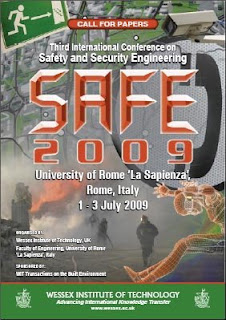
SAFE 2009: Third International Conference on Safety and Security Engineering

Image
THIRD INTERNATIONAL CONFERENCE ON SAFETY AND SECURITY ENGINEERING 2009 (SAFE 2009), 1-3 July 2009, Rome, Italy INTRODUCTION The success of the first two International Conferences on Safety and Security Engineering held in Rome in 2005, and Malta in 2007, has prompted the organisers to reconvene the meeting in 2009. The purpose of the Conference is to provide a forum for the presentation and discussion of the most recent developments in the theoretical and practical aspects of Safety and Security Engineering. Safety and Security Engineering, due to its special nature, is an interdisciplinary area of research and applications that bring together in a systematic view, many disciplines of engineering, from the traditional to the most technologically advanced. The conference covers areas such as crisis management; security engineering; natural disasters and emergencies; terrorism; IT security; man-made hazards; risk management; control; protection and mitigation issues. The meeting aims to ...

Fire Protection Principles in Heritage Buildings

Kidd (2005) and Maxwell (2007) recommended that all fire protection improvements in heritage buildings should follow the following principles: 1 Essential The fire systems should be central to meeting the objectives of the protection of life, buildings and contents. 2 Appropriate to Risk Any system that is installed should be opposite to risks being considered. 3 Compliant with legislation Systems should be installed according to demonstrable performance-based and other legislatively prescribed standards of safety. 4 Minimally invasive The retrospective fitting of fire systems should involve minimal degrees of physical intervention on the historic structure. 5 Sensitively integrated Installed systems should be designed to be integrated sympathetically with the historic fabric and its detail. 6 Reversib...

Regulating Fire Safety in Historic and Cultural Structures

Regulating Fire Safety in Historic and Cultural Structures By: Prof. Vincent M. Brannigan J.D. (2007) ABSTRACT Fires can easily destroy our cultural heritage. Most societies use the legal system to protect against fire. However historic structures are not well protected by typical fire safety codes. First, fire codes are designed to protect lives rather than property. Second, older buildings are usually excused from full compliance with the codes. Third, actual compliance in older buildings may be spotty due to the way such buildings are used. Curators and those responsible for such buildings often have an unrealistically low estimate of the destruction that fire can cause, and may place unreasonable reliance on compliance with a code that is not actually designed to protect historical cultural structures. Resolving this issue requires a novel approach to code compliance. A combination of modern technical analysis and the installation of a properly empowered fire safety controller can ...

Should employees evacuate or be prepared to fight a small fire?

Choosing to evacuate the workplace rather than providing fire extinguishers for employee use in fighting fires will most effectively minimize the potential for fire-related injuries to employees. In addition, training employees to use fire extinguishers and maintaining them requires considerable resources. However, other factors, such as the availability of a public fire department or the vulnerability of egress routes, will enter into this decision. Option 1 Option 2 Option 3 Total evacuation of employees from the workplace immediately when alarm sounds. No one is authorized to use available portable fire extinguishers. Designated employees are authorized to use portable fire extinguishers to fight fires. All other employees must evacuate workplace immediately when alarm sounds. All employees are authorized to use portable fire extinguishers to fight fires. Requirement Requirement Re...

NFPA Publications on Fire Safety, Historic Structures & Museums

Image
1. NFPA 914: Code for Fire Protection of Historic Structures 2. NFPA 170: Standard for Fire Safety and Emergency Symbols 3. NFPA 101A: Guide on Alternative Approaches to Life Safety 4. NFPA 101: Life Safety Code 5. NFPA 909: Code for the Protection of Cultural Resource Properties- Museums, Libraries and Places of Worship

Fire Safety of Cultural Heritage in European Countries

EUROPEAN COUNTRIES- GOALS FOR SOCIETY, BASED ON THE GENERAL FIRE REGULATIONS AND SPECIFIC TO CULTURAL HERITAGE Goal Covered by general Fire Regulations Specific for Cultural Heritage 1. Life and Health Safety Austria, Belgium, Switzerland, Germany, England-Wales, France, Greece, Italy, Norway, Netherlands, Portugal, Sweden, Scotland Switzerland , Italy , Portugal 2. Property Protection a) Structure Austria , Belgium , Switzerland , Germany , Greece , Italy , Norway , Portugal *, Sweden Belgium , Switzerland , Germany , Italy , Norway , Netherlands , Portugal , Sweden b) Content Austria , Switzerland , Greece , Norway , Portugal * Switzerland , Germany , Italy , Norway , Netherlands , Portugal 3. Environment Austria , Germany , Netherlands , Portugal *, Greece Portu...